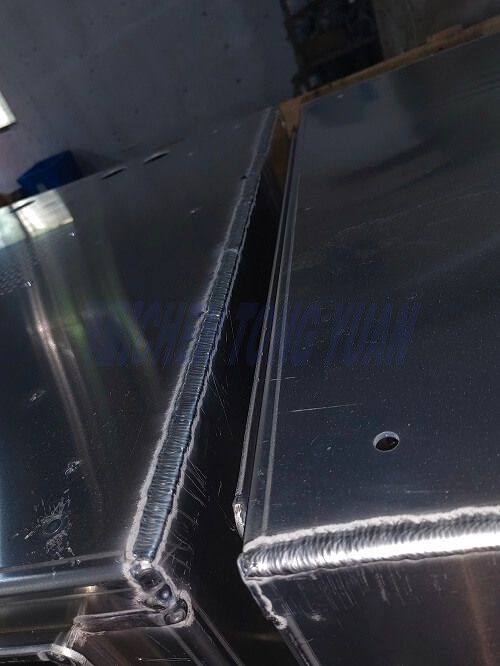
Stainless Steel Welding And Surface Finishing in Telecommunication Cabinets
Views: 0 Author: Renny Publish Time: 2026-03-03 Origin: Site
Article Overview
1.Introduction – Why telecom cabinets need high welding standards
2.Stainless Steel Welding – Methods, applications, and impact on performance
3.Surface Finishing – Brushed vs. powder-coated treatments
4.Choosing the Right Finish – Matching finish to environment and project needs
5.Conclusion – Welding as the foundation, finishing as craftsmanship
In modern telecom infrastructure, from 5G base stations to outdoor transmission nodes, communication cabinets play a critical role in protecting mission-critical equipment and ensuring system reliability.
Yet in practice, a common question arises:
Why do some telecom cabinets remain structurally sound and corrosion-free for years, while others develop weld seam corrosion, door misalignment, or sealing failure?
Why do two cabinets made from the same stainless steel material differ in appearance, cost, and longevity?
The answer lies in a key factor: material is only the foundation—true quality and long-term reliability are determined by stainless steel welding and subsequent surface finishing.
1. Why Telecom Cabinets Require High Standards in Stainless Steel Welding
1.1 Harsh Outdoor Environments
Unlike indoor equipment, telecom cabinets are exposed to demanding conditions:
High humidity and rainfall
Coastal salt spray corrosion
Intense sunlight and large temperature variations
Long-term operation at unattended sites
In such environments, the cabinet is more than an enclosure—it is the first line of defense for system stability.
When environmental stress is unavoidable, manufacturing precision becomes the only controllable variable. High-quality stainless steel welding ensures structural integrity in these conditions.
1.2 Core Requirements: Structural Strength and Sealing
Telecom cabinets must meet:
IP-rated waterproof and dustproof protection
Reliable door sealing
Resistance to wind loads and vibration
Continuous electromagnetic shielding
Poor stainless steel welding—with defects such as porosity, incomplete fusion, or heat distortion—can compromise door alignment, gasket compression, and ultimately the cabinet’s protective performance.
Thus, focusing solely on material thickness is insufficient; welding quality must meet engineering standards.
2. The Role of Stainless Steel Welding in Cabinet Fabrication
2.1 Stainless Steel Material Advantages—But Only the Beginning
Stainless steel is widely used in outdoor cabinet fabrication due to:
Excellent corrosion resistance
High mechanical strength
Long service life
Adaptability to harsh environments
However, material properties alone cannot guarantee product performance.
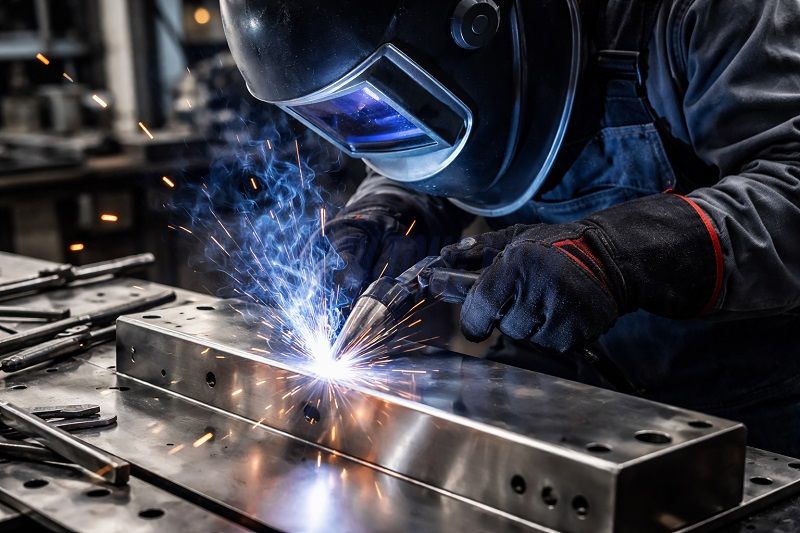
If stainless steel welding is poorly controlled, the heat-affected zone (HAZ) can become a corrosion initiation point. Rough weld seams can compromise both structural integrity and surface finish.
Ultimately, the material’s performance is realized only through precision welding.
2.2 Common Welding Methods and Their Applications
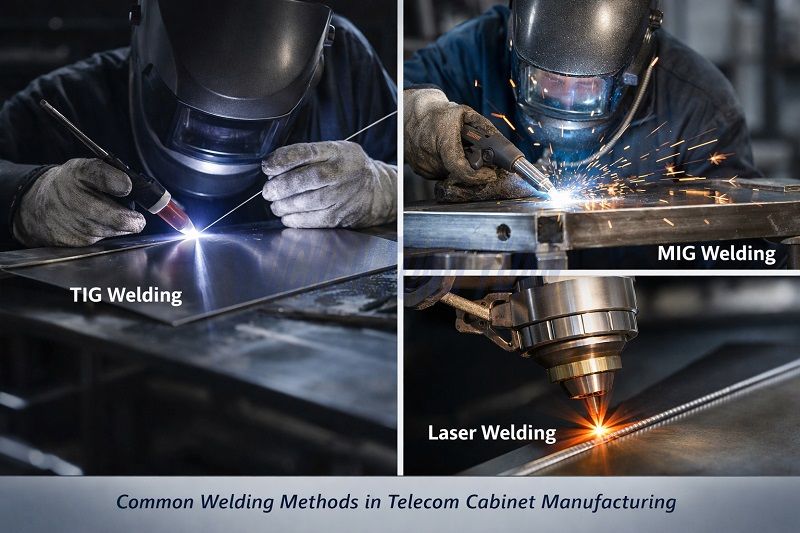
In telecom cabinet manufacturing, typical stainless steel welding methods include:
TIG Welding (Gas Tungsten Arc Welding) Ideal for thin sheets and fine structures, producing clean, visually appealing welds. Often used on external panels with high aesthetic requirements.
MIG Welding (Gas Metal Arc Welding) Suitable for structural components, offering higher efficiency and batch production compatibility.
Laser Welding Provides high precision, minimal heat input, and excellent deformation control—critical for tight tolerances in high-end 5G outdoor cabinets.
Choosing the right welding method depends on the application. Thin-walled outdoor cabinets require careful heat input control to prevent warping that can affect door alignment and sealing performance.
In short, welding is not just a joining process—it is a structural control technique.
2.3 How Welding Quality Impacts Cabinet Performance
The quality of stainless steel welding directly affects:
Overall structural strength
Door alignment and closure precision
Waterproof and dustproof sealing effectiveness
Surface finishing quality
Uneven or insufficient welds can compromise long-term reliability, even with post-weld treatments. Therefore, strict quality control and inspection are standard in telecom cabinet fabrication.
3. Surface Finishing After Stainless Steel Welding
3.1 Weld Grinding and Surface Flatness
After welding, cabinets require:
Removal of weld spatter
Grinding and smoothing of weld seams
Control of surface flatness
Treatment of the heat-affected zone
If these steps are neglected, subsequent finishes such as brushed stainless steel or powder coating will reveal imperfections or reduce durability.
3.2 Brushed Stainless Steel Cabinets
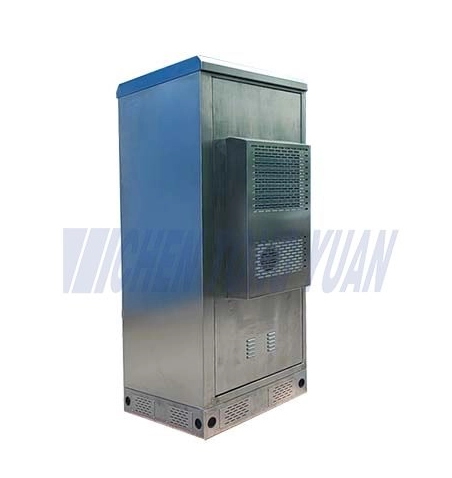
Brushed stainless steel finish creates uniform linear textures, giving a premium industrial look.
Key considerations:
Does not hide welding defects
Requires precise leveling of weld seams
Demands high craftsmanship and manual finishing
As a result, bare brushed stainless steel cabinets often carry higher manufacturing costs due to more complex fabrication processes.
3.3 Powder-Coated Stainless Steel Cabinets
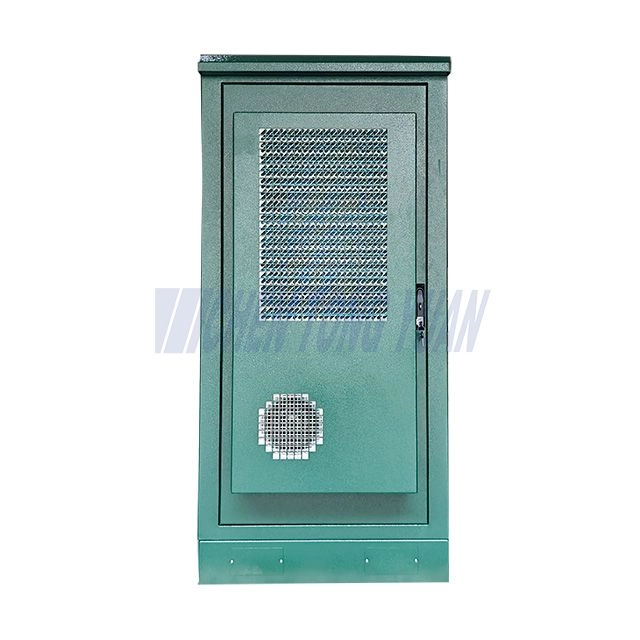
Powder coating involves electrostatic application and thermal curing to form a protective layer.
Benefits include:
Enhanced corrosion resistance
Color customization
Consistent finish for large-scale production
However, powder coating cannot compensate for poor stainless steel welding. Structural flaws or poor welds may lead to:
Cracking of the coating
Hidden corrosion beneath the surface
Reduced long-term durability
Thus, powder coating is a complementary protection strategy built upon solid weld quality.
4. Choosing the Right Finish for Your Telecom Project
In modern telecom infrastructure, cabinet fabrication is a system-level process. Evaluating welding techniques, heat control, and post-weld treatments is more informative than material specifications alone.
Ultimately, what determines the lifespan and reliability of a cabinet is not just what is visible on the surface, but the precision embedded in weld seams and finishing processes.