1. Overview of Powder Coating and Spray Painting for Sheet Metal Cabinets
Surface finishing is a key step in custom sheet metal fabrication. Two main coating systems — powder coating and painting — dominate the market for outdoor electrical cabinets and air conditioner enclosures.
1.1 Powder Coating Process for Metal Enclosure Cabinets
1.1.1Definition of Powder Coating
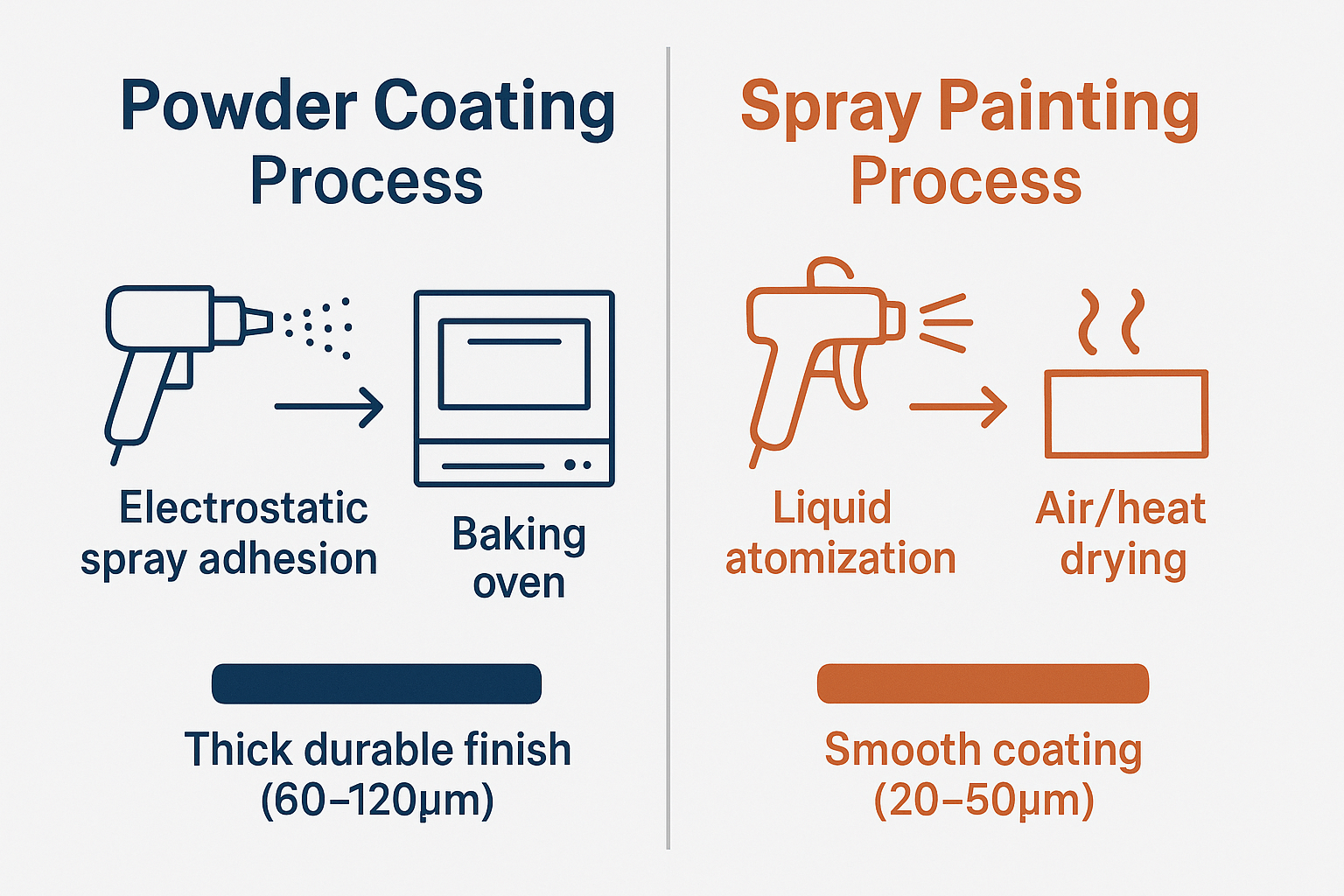
Electrostatic spraying of powder coatings is termed powder coating or spray powdering. Negative-charged paint particles are propelled through an electrostatic spray gun toward positively charged sheet metal, adhering to its surface. After baking, the powder melts under heat, flows, cross-links, and cures into a film. This process yields coatings with matte, sand-textured, or orange peel finishes.
1.2 Spray Painting Process for Industrial Sheet Metal Cabinets
1.2.1Definition of Spray Painting:
Liquid coatings (e.g., acrylic, polyurethane, alkyd) are atomized uniformly via compressed air or high-pressure equipment through a spray gun onto the sheet metal surface, forming a continuous, even paint film. The coating dries naturally or cures under heat on the sheet metal surface, creating a layer with specific adhesion, gloss, and protective properties. High-gloss, matte, or speckled finishes can be achieved.
1.2.2Process Flow:
Pre-treatment (cleaning-grinding) - Primer - Drying - Top coat - Leveling - Curing (ambient or 60-80°C)
2. Comparison of Key Items between Powder Coating and Spray Painting
Item
Powder Coating
Liquid Painting
Material Form
Powder
Liquid
Coating Thickness
60-120μm
20-50μm
Substrate Compatibility
Only materials resistant to 180°C
Suitable for metal/plastic/wood
Weather Resistance
Excellent
Depends on paint type
Appearance
Good (single color), complex color changes
Quick color matching possible
Repairability
Difficult for spot repairs
Easy on-site touch-ups
Material Utilization
90%
50%
Environmental Profile
VOC-free, powder recyclable
VOC-containing, high environmental requirements
3. Important Precautions During Surface Treatment About Sheet Metal Cabinet
Proper handling during surface coating ensures the longevity and functionality of each metal cabinet enclosure. Below are key considerations.
3.1 For Powder-Coated Sheet Metal Cabinets
•Temperature Requirements: Workpieces must be heated to 180-220°C during processing. Materials must withstand high temperatures to prevent deformation.
•Coating Dead Zones: Electrostatic spraying makes deep holes or masked areas difficult to coat. Design should minimize such regions.
• Prevent Clogging: Threaded holes and mating surfaces require shielding to prevent powder clogging that could compromise functionality;
• Fixture Clearance: Reserve mounting points on parts to prevent coating damage where fixtures contact workpieces during handling;
• High-Temperature Deformation: Thin sheets are prone to warping during curing; pre-flatten to ensure flatness of thick sheet metal parts.
3.2 For Painting Sheet Metal Cabinets
•Sags Risk: When painting vertical surfaces, avoid applying thick coats in a single pass to prevent sagging that compromises coating appearance;
•Primer Compatibility: For multi-layer painting, verify compatibility between primer and top coat to prevent adhesion failure or coating cracking;
• Environmental Humidity Control: Excessive humidity in the spray environment may cause defects such as bubbles and white spots. Effective humidity control in the production environment must be considered during design.
•Spray Sequence and Masking: When applying multiple colors, arrange the spray sequence and masking plan reasonably to prevent cross-contamination between coatings.
4. Common Inspection Items and Standards for Surface Treatment of Sheet Metal Cabinets
4.1 Common Testing Items and Corresponding Standards -- Table Display
Inspection Item
Purpose General
Requirements
Applicable Standard
Visual Inspection
Check coating quality and defects
No sagging, particles, pinholes, or bare spots
GB/T 9761-2008 “Evaluation of Appearance of Coatings of Paints and Varnishes”
Film Thickness
Verify coating thickness meets specifications
Powder Coating:
Flat Texture: 50-80μm;
Sand Texture: 60-100μm;
Orange Peel Texture: 60-120μm;
Spray Painting: 30-60μm
GB/T 4956-2003
“Non-Magnetic Coatings on Magnetic Substrates - Measurement of Coating Thickness - Magnetic Method”
GB/T 4957-2003 “Non-conductive Coatings on Non-magnetic Metal Substrates - Measurement of Coating Thickness - Eddy Current Method”
Adhesion
Check coating bond strength to substrate
Grade 0-1 Pass (≤5% peeling)
GB/T 9286-2021 “Cross-Hatch Adhesion Test for Paints and Varnishes”
GB/T 5210-2006 “Adhesion Test of Paints and Varnishes by Pull-Off Method”
Impact Resistance
Testing coating resistance to mechanical impact
No cracking/delamination at 50 cm·kg positive impact
GB/T 1732-2020 “Determination of Impact Resistance of Paint Films”
Artificial Atmosphere Corrosion Tests - Salt Spray Test
Hardness Testing
Tests coating abrasion/scratch resistance
≥2H GB/T 6739-2022
“Paints and Varnishes - Determination of Hardness of Paint Films by the Pencil Method”
Color Difference Test
Testing color consistency
AE≤1.5 (Industrial Parts)
GB/T 11186.3-1989 “Measurement of Paint Film Color - Part 3: Calculation of Color Difference”
4.2 Common Testing Items and Corresponding Standards -- Supplementary Notes:
1. Cross-cut adhesion test standard grading: 0 (best) ~ 5 (worst), generally industrial requirements are no less than 1;
2. Pencil hardness reference grade: H > HB > B, industrial coatings usually require 2H~3H;
3. Color difference AE (Lab value):
AE≤1.0 → High requirement;
AE≤1.5 → General industrial parts, industrial equipment housings;
AE≤2 → Low requirement acceptable, non-visible structural parts, heavy equipment concealed parts can be relaxed to AE≤2.5;
AE>3.0 → Significantly visible difference, usually unacceptable.
5. Corrosion Classifications (C1–C5) for Outdoor Sheet Metal Cabinets
This classification is defined based on the mass loss and film thickness loss caused by corrosion of standard components in the first year under different environments.
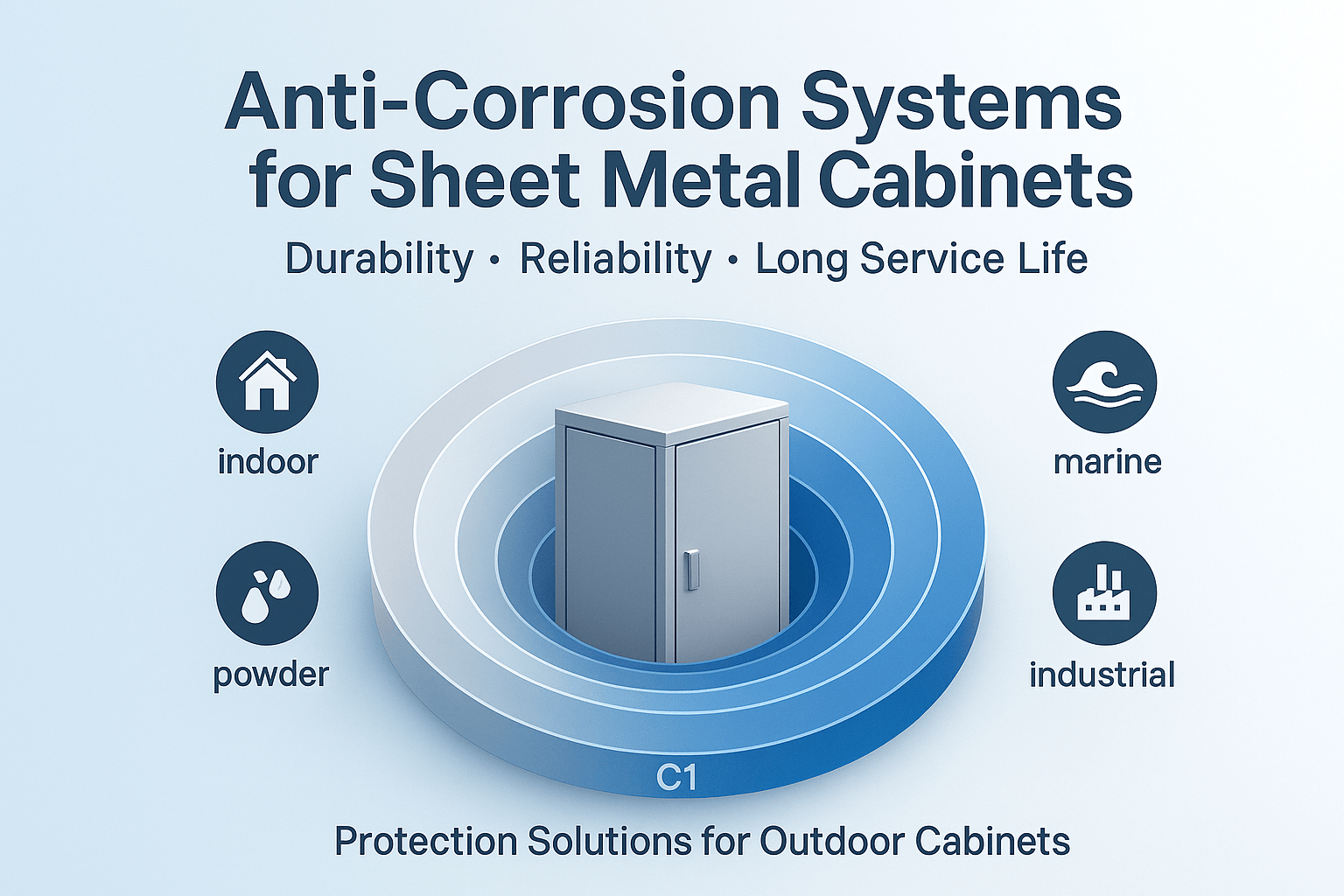
The corrosion environment classification defines how long a metal enclosure cabinet can endure under different atmospheric conditions:
(Based on GB/T 30790.2)
Corrosion Category
Environmental Description (Typical Examples)
First-Year Mass Loss of Carbon Steel (μm)
Typical Environment
Equivalent Salt Spray Test Duration
C1
Very Low
≤ 1.3
Heated, clean indoor spaces such as offices, schools, hotels
> 250 hours
C2
Low
>1.3 to 25
Areas with low atmospheric pollution, most rural regions
> 250 hours
C3
Moderate
>25 to 50
Urban and industrial atmospheres, moderate sulfur dioxide pollution, low-salinity coastal areas
≥ 480 hours
C4
High
>50 to 80
High-salinity industrial zones and coastal areas (e.g., chemical plants, swimming pools)
≥ 720 hours
C5-I
Very High (Industrial)
>80 to 200
Industrial areas with high humidity and corrosive atmospheres
≥ 1200 hours, even ≥ 2000 hours
C5-M
Very High (Marine)
>80 to 200
Offshore areas and coasts with high humidity and salinity
≥ 1200 hours, even ≥ 2000 hours
Important Note:
In C5-I, "I" represents an industrial environment.
In C5-M, "M" represents a marine environment.
6. Recommended Anti-Corrosion Solutions for Sheet Metal Cabinets
For manufacturers like Cytech, choosing the right corrosion protection system is essential to extend the service life and reliability of sheet metal cabinets. Whether used for outdoor power systems, telecom enclosures, or industrial control boxes, the coating process directly affects long-term durability.
6.1 Liquid Coating Systems (C1–C5)
Different environments require different coating combinations to resist corrosion effectively.
C1–C2 (Low Corrosion) – For indoor or rural conditions, a simple primer and top coat (epoxy or phosphate primer + acrylic or alkyd top coat) is sufficient. Typical design life: 5–15 years.
C3 (Moderate Corrosion) – Common in urban and light industrial areas. Recommended system: epoxy zinc-rich primer + MIO intermediate + polyurethane top coat for improved adhesion and weather resistance. Design life: ~15 years.
C4 (High Corrosion) – Suitable for coastal or chemical environments, using epoxy zinc-rich primer + epoxy MIO + fluorocarbon or PU top coat. Design life: 15+ years.
C5 (Very High Corrosion) – For marine and heavy industrial zones, adopt thermal spray zinc/aluminum + epoxy MIO + fluorocarbon top coat, ensuring maximum barrier and gloss retention. Design life: 15–25 years.
6.2 Powder Coating Systems
Powder coating is widely used for its smooth finish, efficiency, and environmental benefits. Cytech applies tailored systems for each corrosion class:
C1–C2: Epoxy or polyester powders with phosphating or blasting pretreatment, 60–80 μm thickness.
C3: UV-resistant polyester or polyurethane powders, 80–100 μm.
C4: Epoxy zinc primer + powder top coat hybrid system, achieving long-term protection for outdoor cabinets (>15 years).
C5: For harsh marine conditions, use liquid epoxy primer + epoxy MIO + powder top coat for enhanced cathodic and barrier protection.
6.3 Hybrid and Alternative Coating Solutions
E-Coating (Electrophoretic) + Powder Coating: This process ensures uniform coverage even inside welds and corners, achieving up to 1000 hours of salt spray resistance. Ideal for energy storage and telecom sheet metal cabinets.
Hot-Dip Galvanizing + Powder Coating: Combines zinc’s sacrificial protection with polyester powder’s UV resistance, offering one of the most durable systems for marine and industrial conditions.
6.4 Emerging Green & Nano Technologies
The future of corrosion protection lies in sustainability and smart coatings. Modern waterborne, high-solid, and low-VOC systems reduce environmental impact without sacrificing durability. At the same time, nano-enhanced coatings—including graphene and nano-silica technologies—provide superior scratch resistance, UV stability, and barrier performance, allowing for longer service life and reduced maintenance.
7.Inquiry
Selecting the right anti-corrosion system for a sheet metal cabinet depends on its application environment, expected lifespan, and budget.
Cytech recommends a hybrid coating approach—combining powder, liquid, and nano technologies—to achieve the perfect balance of durability, aesthetics, and environmental responsibility.
If you have corrosion resistance concerns with sheet metal outdoor telecom cabinets or energy storage enclosures, please contact Cytech. Our engineering team specializes in custom sheet metal cabinet design, precision fabrication, and advanced coating systems tailored for extreme environments. We help you build a durable, corrosion-resistant metal cabinetthat ensures long-term reliability and performance in C4 and C5 conditions.